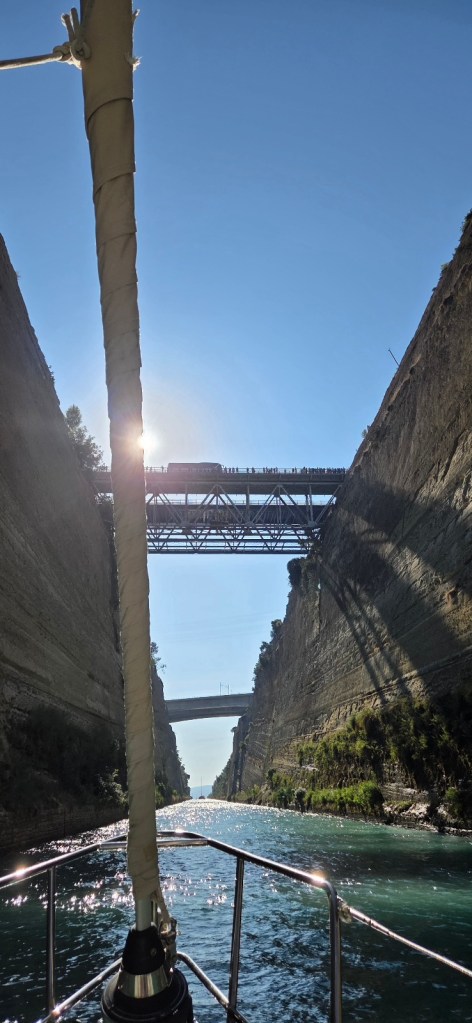
Quintessa has now left behind the Ionian Sea and have entered the Aegean. Like many sailors over the centuries, we knew the trip around the Peloponnese could be long and potentially dangerous. Fortunately for us, there is an alternative—the Corinthian Canal. The canal, which was completed in 1893, is literally a 4-mile long ditch that connects the Ionian and the Aegean at sea level. Because it is only 80 feet wide and therefore cannot accommodate large ships, Wikipedia notes that “It is currently of little economic importance and is mainly a tourist attraction.” Well, these tourists were happy it exists. At the ends of the canal we could see evidence of the ancient Diolkos, a track over which for centuries, cargo and even entire ships were hauled the 4 miles as an alternative to the arduous journey around the peninsula.
We made a reservation to traverse the canal and paid a fee, then stood by outside the west entrance awaiting radio instructions. The canal is one way, and normally the boats wait for the traffic from the other direction to clear, but it must have been a slow day, because no vessels appeared before Quintessa was called by name to join the line-up. We entered the canal, following instructions to maintain 7 knots of speed.
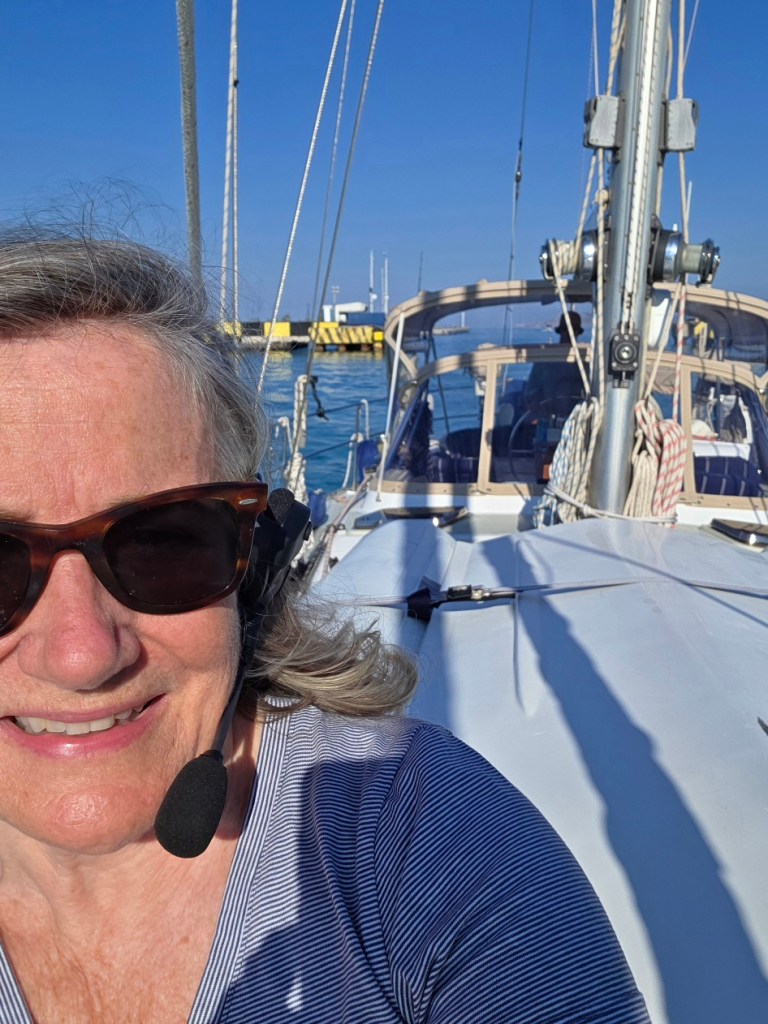
Prior to this day, we had encountered high bridges, floating bridges, raised bridges and rotating bridges, but as we entered the canal we experienced our first sinking bridge. The roadway is a metal grate that actually sank on a track so that it sat on the bottom of the canal as we passed over (the bridge is yellow and black, behind me in the photo). Then the walls of the canal rose around us as we moved through the isthmus. The narrow ditch is carved out of not-so-hard rock and clay, and we could see that it continues to erode, which is why it is closed every Tuesday for repairs. After gaping at the high walls and waving at the pedestrians on the high bridge near the east end, we emerged from the experience and it was time to seek out new lands in the Aegean.


 kateandjohnsail.boats
Leave a comment