Boaters, you can take a nap now, because you know this, but I thought others might be interested in learning how we identify other craft that are sharing the waters with us. Knowing a bit about the other boats is not only interesting, it enables us to respect other ships and avoid collisions at sea.

Most vessels at sea transmit a signal via AIS, or Automated Identification System. Each boat has a unique signal and is registered, so when we receiive the signal of another boat, we can get information about the vessel and also about its position and speed in the water.

A case in point: recently I saw a big ship that was white like many ferries, so I wondered what it was. The first thing to do is look on the chartplotter in front of me and identify the little icon that is in the position I am looking for relative to Quintessa (we are the black boat icon). I touch the icon on the screen and it tells me there is AIS data, and one screen later there is a wealth of information available to me.

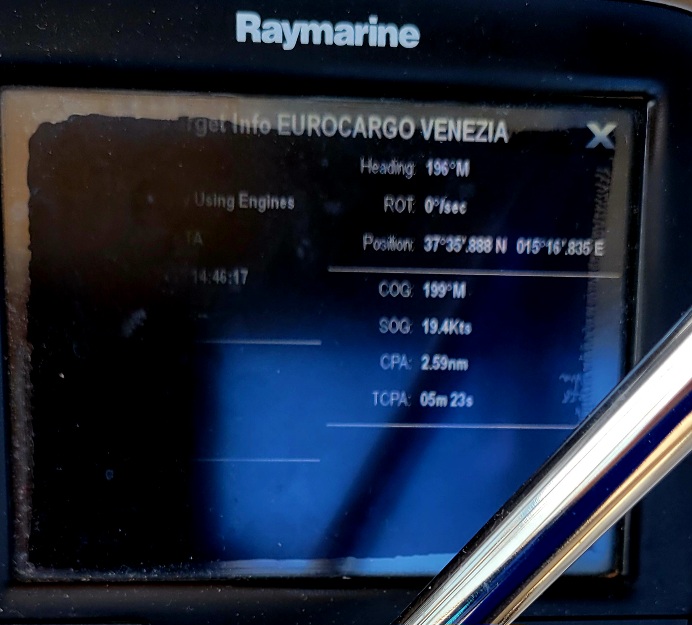
Here is what we learn: it is a cargo ship, the EUROCARGO VENEZIA. It is traveling from IT LIV (wherever that is) to IT CTA, which I assume is Catania, right near where we were. (This would be the Catania in Sicily, by the way, sitting right under a very shrouded Mt. Etna, which apparently has been quite busy erupting recently.) The VENEZIA is 200 meters long and 25 meters wide, with a draft of 8 meters. Clearly, we want to keep our distance, which is why the next information is critical. There is information about the ship’s bearing (direction of travel) and velocity, 19.4 knots, nearly 3 times our current speed. But here are the numbers I look for: CPA: 2.59nm and TCPA: 05m23s. This means that if both vessels maintain their course and speed, the nearest we will be to the VENEZIA will be two and a half nautical miles, and it will happen in just over 5 minutes. No worries. If the Closest Point of Approach is under a mile, we will decide whether to make a slight course adjustment to keep the distance comfortable. This is not a big deal in the daytime, but it’s comforting at night to know we can avoid close encounters.
Looking up AIS information on the vessels nearby can be entertaining, as there are many kinds of craft out there. Other boats look up our information and occasionally hail us on VHF radio. One night last week, a fishing vessel hailed Quintessa, Quintessa, while I was on watch. Unfortunately, il capitaine spoke only rapid Italian, and all I could say was non capisco, non capisco. I guessed he didn’t want me scaring his fish, and just gave his boat a wide berth.
You can look us up on AIS if you want to, on websites like Find Ship, Marine Traffic, or Vessel Finder. There are several Quintessas, so look for the one that is US flagged and registered in Delaware.


 kateandjohnsail.boats
Leave a comment